
Free guide and template
Plan the first 90 days of outbound before you increase the volume.
An editable campaign planner covering targeting, infrastructure, messaging, handoffs and weekly learning.
PDF · Editable XLSX. Free. Short form.
Who it is for
Established B2B teams turning targeting and qualification decisions into one owned, measurable campaign.
The question it answers: What must we prepare, launch, measure and improve during the first cycle?
What you will be able to do
- Assign owners and days to every part of the first cycle.
- Check the launch prerequisites before any volume goes out.
- Record tests, results and caveats, and decide what to scale, revise or stop.
A look inside
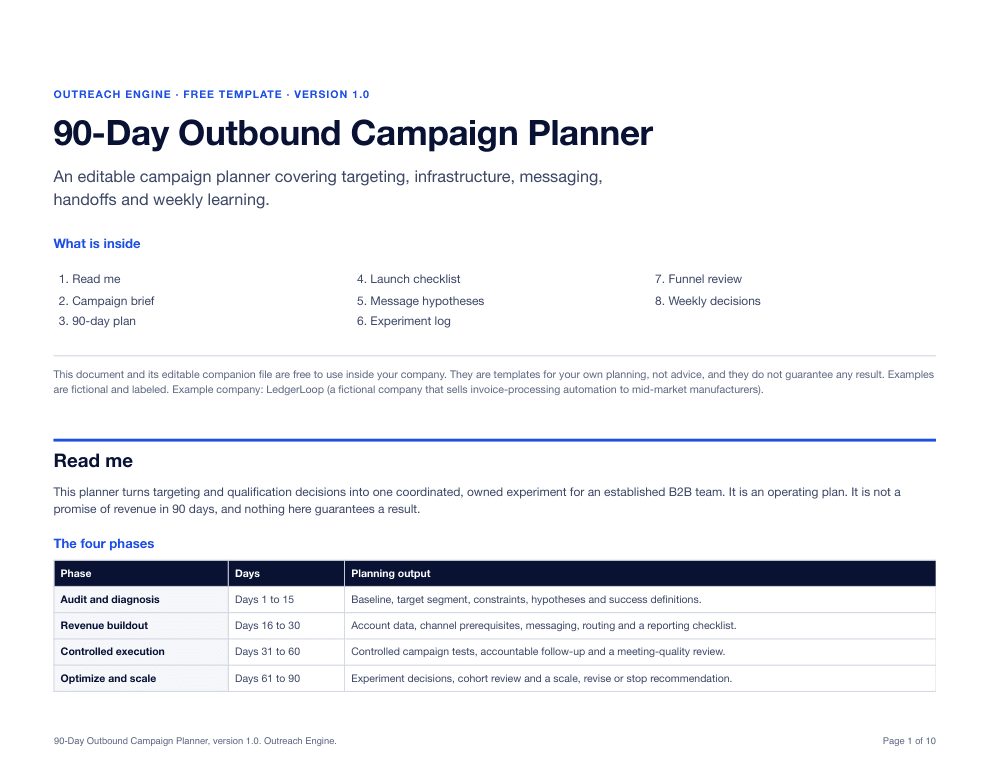
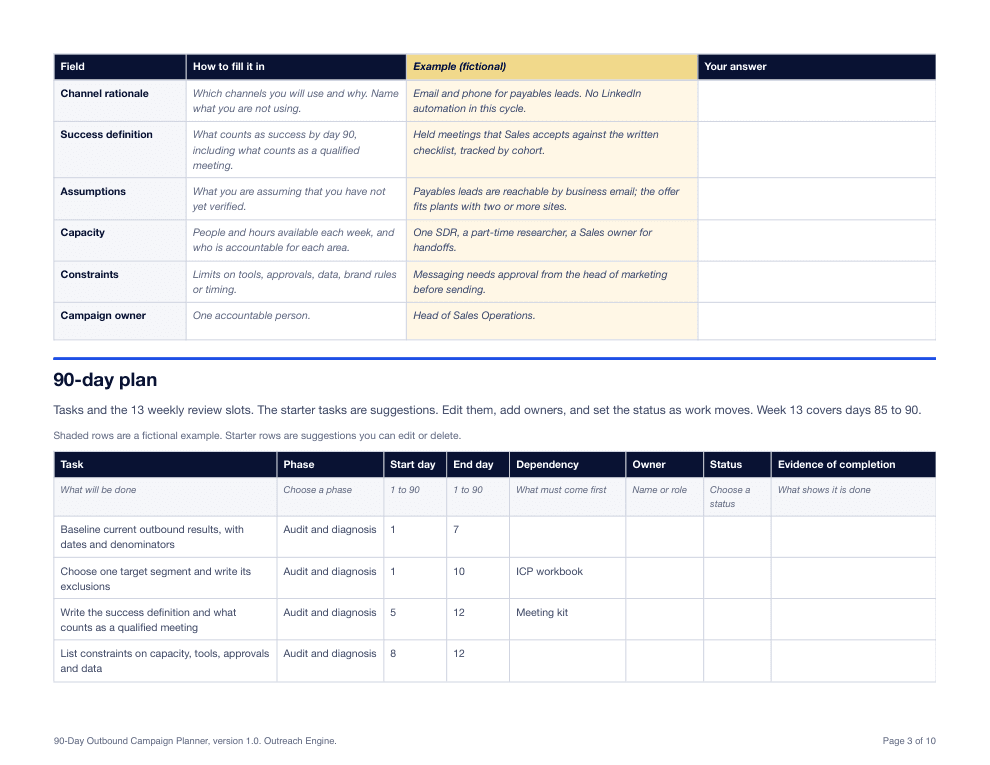
These are pages from the actual PDF, not mockups.
What is inside
Campaign brief
Segment, offer, channels, success definition, assumptions and capacity on one page.
90-day plan
Tasks across four phases, with owners, status, evidence and 13 weekly review slots.
Launch checklist
Data, sending setup, suppression, approvals, replies, handoffs and tracking.
Message hypotheses
Audience, trigger, problem, proof, opening angle and what each test should teach you.
Experiment log
Hypothesis, variable, denominator, observation, caveat and decision.
Funnel review and weekly decisions
Cohorts with visible denominators, and a stop, keep or test decision each week.
Fictional example, free to read
A worked example: one campaign brief
The one-page brief that anchors the planner, filled in for a fictional company that sells invoice-processing automation. Every detail is invented.
| Field | Example answer (fictional) |
|---|---|
| Target segment | Food and beverage manufacturers with a mid-market ERP. Excludes current customers and open opportunities. |
| Offer | A walkthrough of how invoice approvals can move out of email while the ERP stays the system of record. |
| Channel rationale | Email and phone for payables leads. No LinkedIn automation in this cycle. |
| Success definition | Held meetings that Sales accepts against the written checklist, tracked by cohort. |
| Assumptions | Payables leads are reachable by business email; the offer fits plants with two or more sites. |
| Capacity | One SDR, a part-time researcher, a Sales owner for handoffs. |
| Constraints | Messaging needs approval from the head of marketing before sending. |
| Campaign owner | Head of Sales Operations. |
How to use it
- Fill in the campaign brief for one segment.
- Edit the starter tasks and assign owners.
- Work through the launch checklist before sending volume.
- Log every test with the one variable you changed.
- Review cohorts and record a weekly decision.
Files and formats
| File | Size | Use it to |
|---|---|---|
| 387 KB, 10 pages | Read it and print it | |
| Editable XLSX | 24 KB | Fill it in, in Excel or Google Sheets |
Version 1.0, updated October 9, 2026.
Frequently asked questions
Does the planner promise results in 90 days?
No. It is an operating plan. The four phases mirror how Outreach Engine runs its own cycle, and the planner is built to produce evidence and a decision, not a guaranteed outcome.
Does it recommend how many emails to send?
No. Safe volume depends on your sending setup and the providers you reach, so the planner points you to current provider guidance and makes you assign an owner for monitoring instead of inventing a limit.
How does it handle results that are not known yet?
Leave the cell blank. The funnel tab treats a blank as unknown rather than zero, and pending deals are never counted as losses.
Can I use it without the other resources?
Yes. It links to the ICP workbook and meeting kit where they help, but each file works on its own.
Optional next step
You can use everything here on your own. If you would rather talk it through, the diagnosis is a 30 minute conversation about your market and outbound.
More free resources
Related services
Ready to turn cold prospects into booked meetings?
Get a pipeline plan built around your ICP, your deal size and the channels your buyers actually answer.
Build my pipeline