
Free guide and template
Agree on what a qualified meeting actually means.
A practical acceptance checklist, handoff template and review log for keeping SDRs and Sales aligned.
PDF · Editable DOCX. Free. Short form.
Who it is for
Marketing, SDR and Sales leaders who need to agree what a qualified meeting is and what Sales must receive.
The question it answers: What makes a meeting worth accepting, and what must Sales receive?
What you will be able to do
- Write down what makes a meeting worth accepting, before the next campaign launches.
- Give Sales a complete handoff, with context, objections and a clear purpose.
- Record rejection reasons so patterns show up instead of arguments.
A look inside
These are pages from the actual PDF, not mockups.
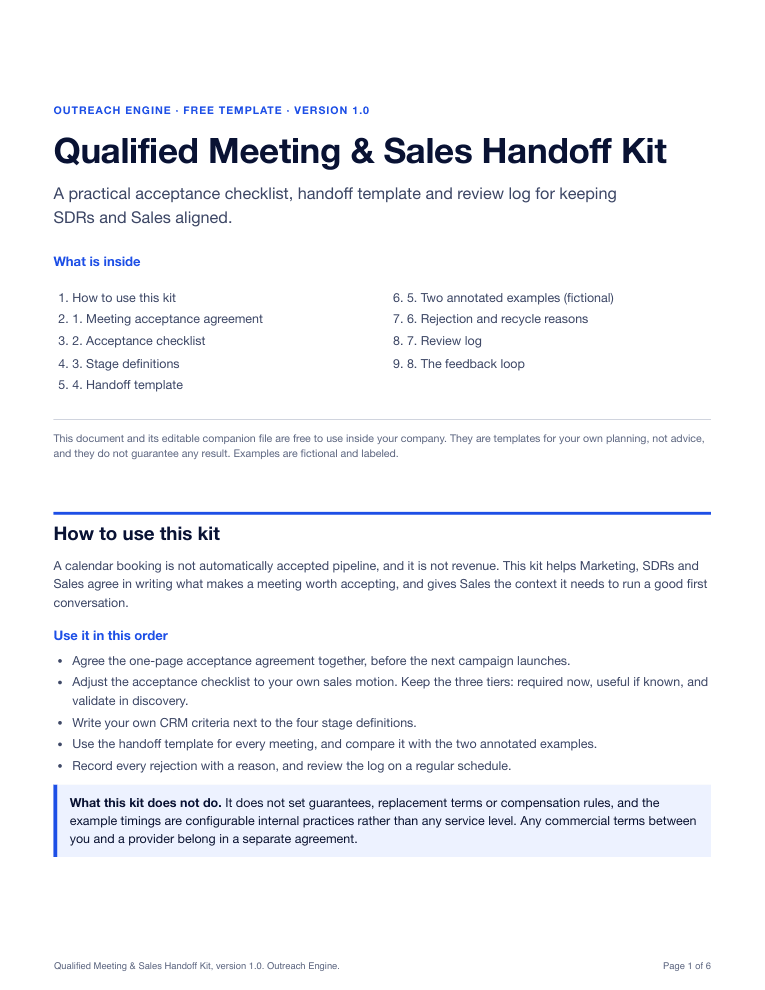
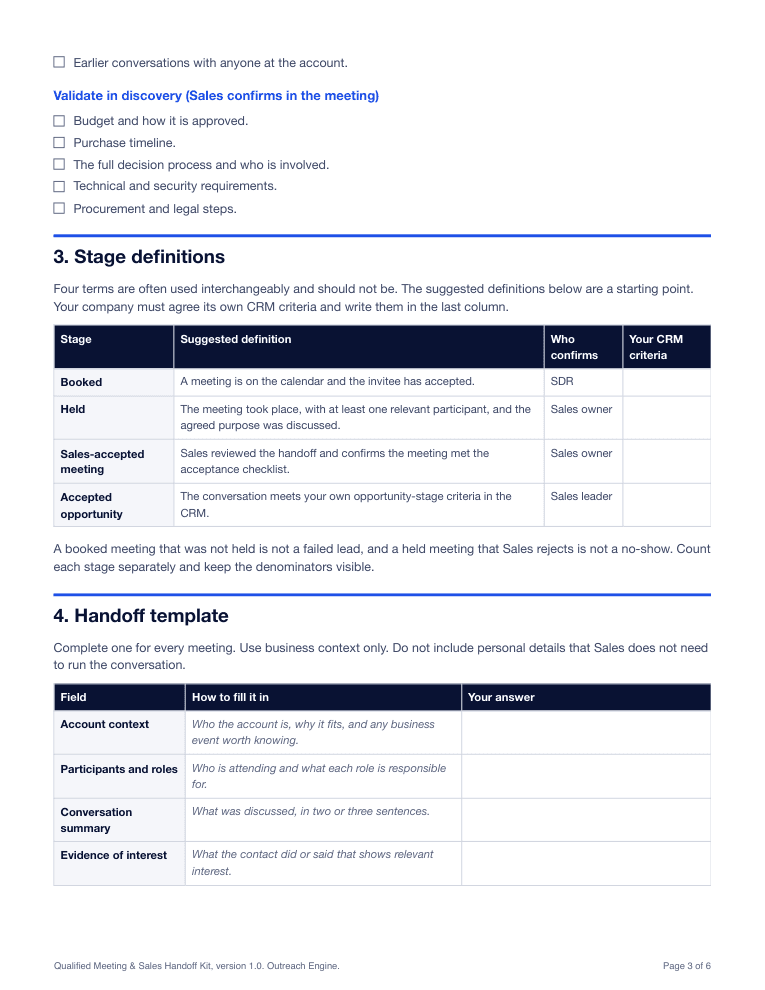
What is inside
Meeting acceptance agreement
One page that SDR and Sales leaders agree on and keep.
Acceptance checklist
Three tiers: required now, useful if known, and validate in discovery.
Stage definitions
Booked, held, sales-accepted meeting and accepted opportunity, with space for your own CRM criteria.
Handoff template
Account context, roles, summary, evidence of interest, objections, prior touches and next action.
Two annotated examples
A good handoff and a weak one, both fictional, with notes on the difference.
Rejection reasons and review log
Six defined reasons, a log, and a simple process for resolving disagreement.
Fictional example, free to read
A worked example: a good handoff and a weak one
Both handoffs are invented. The third column explains what makes the first useful and what the second leaves out.
A good handoff
| Field | What the SDR wrote | Why it works |
|---|---|---|
| Account context | Mid-size food manufacturer in the target segment. Opened a second plant, per a press release. | States the fit and a business event with a source. |
| Participants and roles | Payables lead (champion). Controller may join. | Roles, not just names, and flags who might attend. |
| Conversation summary | Payables lead said approvals run through a shared mailbox and slow month-end close. | Specific problem in the contact's own terms. |
| Evidence of interest | Replied to the second message and asked to see how approvals could move out of email. | Shows the contact took an action. |
| Objections raised | Asked whether the ERP would stay the system of record. Answered yes. | Records the concern and the answer. |
| Meeting purpose | Walk through the approval flow and decide whether a deeper review is useful. | A purpose Sales can open with. |
| Next action | Sales owner sends a short walkthrough agenda the day before. | Owner, action and timing are clear. |
A weak handoff
| Field | What the SDR wrote | What is missing |
|---|---|---|
| Account context | Good company. | No fit, no source, no event. |
| Participants and roles | Jordan. | No role, so Sales cannot judge relevance. |
| Conversation summary | Interested in a demo. | No problem, no detail and no words from the contact. |
| Evidence of interest | Said yes. | Does not say to what, or why. |
| Objections raised | None. | May be true, but no one can tell whether anyone asked. |
| Meeting purpose | Demo. | Sales cannot tell what the contact expects to see. |
| Next action | Call them. | No owner, no date and no context. |
How to use it
- Agree the one-page acceptance agreement together.
- Adjust the checklist to your own sales motion.
- Write your CRM criteria beside the four stage definitions.
- Use the handoff template for every meeting.
- Review the log on a schedule both teams agree.
Files and formats
| File | Size | Use it to |
|---|---|---|
| 213 KB, 6 pages | Read it and print it | |
| Editable DOCX | 42 KB | Edit it in Word or Google Docs |
Version 1.0, updated October 9, 2026.
Frequently asked questions
Does the kit say what counts as a qualified meeting?
It gives you a structure and suggested definitions. Your company decides its own criteria and CRM stages. A booked meeting is not accepted pipeline until Sales has agreed it meets those criteria.
Do prospects have to give a budget before a first meeting?
No. The checklist separates what is required now from what is useful if known and what Sales validates in discovery. Exact budget and purchase date sit in the last group.
Does this set guarantees or replacement terms?
No. The kit contains no guarantees, compensation rules or contractual commitments. Example timings in it are configurable internal practices, not a service level.
Why is a no-show separate from poor fit?
A no-show says nothing about whether the account was right. Mixing the two hides which problem you actually have.
Optional next step
You can use everything here on your own. If you would rather talk it through, the diagnosis is a 30 minute conversation about your market and outbound.
More free resources
Related services
Ready to turn cold prospects into booked meetings?
Get a pipeline plan built around your ICP, your deal size and the channels your buyers actually answer.
Build my pipeline